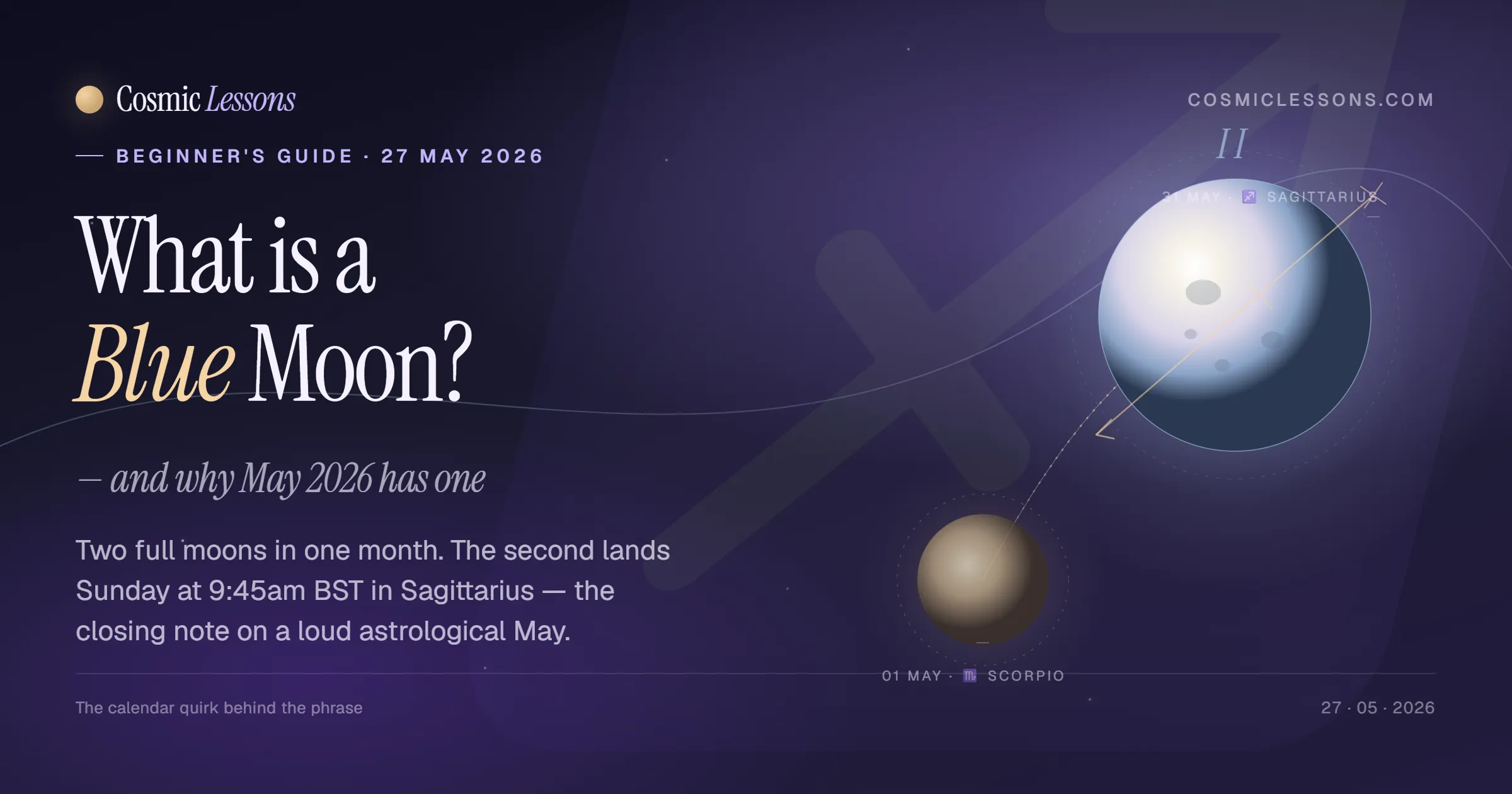
You've probably heard the phrase "once in a blue moon." It means something rare, something that doesn't come around often. The astrological version is less poetic but more useful: a Blue Moon is simply the second full moon in a single calendar month. And this month, we've got one.
May's first full moon - the Full Moon in Scorpio - arrived on May 1st. The second lands on Sunday 31 May at 9:45am BST (08:45 UTC), this time in Sagittarius. Two full moons, one month. That's your Blue Moon.
Why Does It Happen?
The Moon completes a full cycle - new moon to full moon and back - roughly every 29.5 days. Most calendar months are 30 or 31 days long. Usually the timing works out so there's only one full moon per month, but occasionally the maths lines up and you get two. It happens about once every two and a half to three years.
There's nothing astronomically exotic going on. The Moon doesn't change colour. It doesn't behave differently. But in astrology, the fact that we get two full moons in a single month does carry meaning, because full moons are moments of culmination - and getting two in quick succession creates a kind of double emphasis on whatever themes that month has been working through.
What Makes This One Worth Paying Attention To
May 2026 has been an unusually intense month astrologically. The Taurus stellium at the start of the month concentrated energy around values, security, and what we're building. The New Moon in Taurus on 16 May planted seeds in that territory. The Sun conjunct Uranus in Gemini on 22 May was a flash of clarity and disruption. And the Mars square Pluto on 25–26 May pressure-tested whatever had surfaced.
The Blue Moon on the 31st is the full stop at the end of that sentence. It arrives in Sagittarius - the sign of meaning, belief, the bigger picture, the question of what you're actually aiming for. After a month of grounding, disruption, and confrontation, Sagittarius asks: so what did you learn? What do you believe now that you didn't before?
The fact that it's a Blue Moon - the second culmination point this month - suggests that whatever is coming to a head on the 31st has been building since the Scorpio Full Moon on 1 May. A full month of emotional processing, condensed into a single closing moment.
See where the Blue Moon lands in your chart
Your personal transit page shows exactly which house Sagittarius occupies in your chart, what natal placements are being activated, and how this full moon shows up in your own life.
Subscribe to Cosmic LessonsBlue Moon vs Full Moon - Is There a Difference in Astrology?
This is a question that comes up a lot, and the honest answer is: it depends on who you ask.
Some astrologers treat Blue Moons as amplified full moons - the idea being that getting two in one month doubles the intensity of the lunar cycle. Others don't give the Blue Moon label any special weight and read it the same as any other full moon, purely based on the sign, degree, and aspects involved.
The approach we take at Cosmic Lessons is somewhere in the middle. The "Blue Moon" part is a calendar quirk - it's about our months being slightly longer than the lunar cycle, not about anything the Moon itself is doing differently. But context matters. When a Blue Moon falls at the end of a month that's been as astrologically loaded as May 2026, the timing feels significant regardless of whether you give the label extra weight. It's less about the name and more about the accumulation.
What to Know Before Sunday
We'll be publishing a full breakdown of the Blue Moon in Sagittarius on Friday - the aspects, the degrees, what it means for your chart, and how to work with it. If you want to understand the astrology in detail, that's the post to watch for.
For now, the short version: this is a moment of release and clarity. Sagittarius full moons ask you to zoom out. After weeks of close-up, ground-level intensity, the view from altitude can be a relief. What's the bigger story? What thread connects everything that's happened this month? What are you ready to let go of, and what do you want to carry forward?
If you've been following the Cosmic Lessons blog through May, you've watched the month build in real time. The Blue Moon is where it lands.
New to Astrology?
If terms like "full moon in Sagittarius" or "aspects" feel unfamiliar, we've been building beginner guides on Cosmic Lessons that explain the basics in plain English - what the signs mean, how the Moon's cycle works, what full moons actually do in your chart. They're designed so you can read a post like this one and actually understand the mechanics behind it, not just take someone's word for it.
FAQ
What is a Blue Moon?
A Blue Moon is the second full moon in a single calendar month. It happens roughly once every two and a half to three years because the lunar cycle (29.5 days) is slightly shorter than most calendar months.
When is the Blue Moon in May 2026?
Sunday 31 May 2026 at 9:45am BST (08:45 UTC). It falls at 9°56' Sagittarius.
Does a Blue Moon look different?
No. The Moon doesn't change colour or appear different during a Blue Moon. The name refers to the calendar timing, not the Moon's appearance.
Is a Blue Moon more powerful in astrology?
Opinions vary. Some astrologers consider Blue Moons to carry amplified full moon energy. Others read them identically to any other full moon. What most agree on is that the context of the month matters - and May 2026 has been an unusually intense one, which gives this Blue Moon extra weight regardless of the label.
Which signs are most affected by the Blue Moon in Sagittarius?
People with natal planets or points near 6–14° of the mutable signs - Sagittarius, Gemini, Virgo, and Pisces - will feel it most directly. But everyone has Sagittarius somewhere in their chart, so it touches a specific area of life for everyone.
Want to see where the Blue Moon falls in your chart? See it in Cosmic Lessons ~ £14.99/month, cancel any time.